Exoborne - AAA extraction Shooter
Company: Sharkmob
Role: Game Designer
Period: 2020-2025
During my time, I assisted in many aspects of the project. I worked on iterations of the player inventory systems, world events/hazards, player quest rewards, merchant and crafting/recycling features. But my main legacy is the design and implementation of looting and distribution systems. Here is an overview of some of these systems, what worked/didn’t work, and my thoughts on improvements.
Given Directors Intent
I want players to find deterministic loot in areas and enemies but each time the experience should be slightly different.
My interpetation
Players will repeatedly visit the same areas over and over. The systems and design should mitigate the feeling of repetitiveness as much as possible.
There needs to be patterns and contextual rules to where certain item categories can be found that players will learn and understand over time.
To elaborate, items have rules to what biomes or type of sources they can spawn in depending on item category, rank, etc.
Items can be found in a predetermined sources or locations but are not guaranteed.
Sources for items are determined per area, but that does not mean that they need to spawn in the same location or at all (if unlucky). Example:
Metal can be found around industrial places, inside shipping crates and might be dropped by robots.
Higher ranked weapons can be found in locked chests or Elite enemies.
The Design and execution
I assisted in the creation of multiple systems that when setup correctly would work together to give players a varied experience each time they visited a location. While also giving a designer the possibility to be flexible in creating major changes to the loot experience in short time. Many of the involved actors were prototyped, created or maintained by me through visual scripting. While these systems went through countless iterations, the key aspects where:
ITEMS & LOOT CONTAINERS
To be able to control distribution and balance of items and containers (chests/crates/etc), all loot related actors in the game need to be tagged with at least a category and rank. But to give us designer more control they could also be given tags for areas, enemy, factions and other custom needs. Example:
Cables: Resource, electronic, common, residential, industrial.
Locked Chest: Container, epic, enemy fortress, storage.
Note: Containers went through several UX iterations on the “opening experience”. While my personal preference is the piñata (or loot fountain) approach we decided to go with a more traditional “loot window” due to performance and and audience expectations.
LOOT TABLES
A way to assign what loot to what source (area, container, enemy, etc) and the chances.
SPAWN POINTS
Decided what item or container could spawn in desired location. A container point could be customized to spawn a dedicated actor or spawn any container that met it’s conditions. Like spawn legendary container or container of X size.
LOOT VOLUMES
Or loot controllers. These orchestrated spawning logic and what loot category was assigned to an area. And besides loot tables, these where the main lever for us designer to give a varied experience to players each time they would visit an area. Example:
X volume want to spawn hospital assigned loot actors of rank 1-5. With lower ranks being more common.
Only activate 8-10 of the spawn points present inside a volume. The others remain dormant until activated by the respawning logic. That means that if you found loot at spawn point Y, loot might respawn on location Z next time.
Volumes could overlap, but the smaller one always had the prio of controlling the overlapped points. Used to have different loot in a “secret hideout room” as an example.
Here is a visual aid how a simple setup could look like in a level:
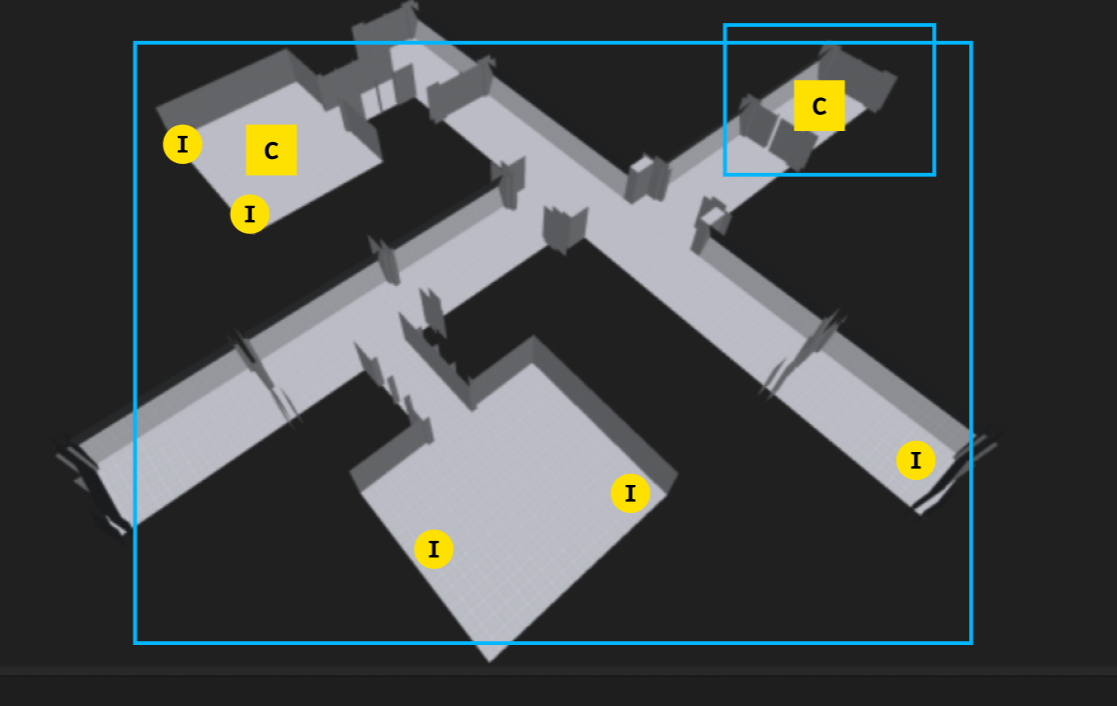
Legend
Blue rectangles = Loot volumes
I = Item spawn points
C = Container spawn point
Results and Final thoughts
PROS
The tag and loot table setup enabled vast and big changes in short time. We had several directional pivots during development and with our setup we could change the loot for the entire game in a couple of days once a plan was made.
Due to efficient import and export excel tooling, we could speed up balance work, automate setups and make player loot simulations with more accurate data.
All balancing issues in loot tables and loot volume settings could be hot fixed once live.
World or live events could affect loot configurations of areas and sources.
CONS
Very human error prone. But we managed to mitigate most through tooling and automation processes.
Once live, volume and spawn point placement can’t reliably be hot fixed so any updates usually need to be part of a patch. There were workarounds but they could have unintended ripple effects on other areas with a similar loot setup.
For best performance, these systems were designed with a dedicated “loot team” from various disciplines in mind. If production reprioritizes man power, managing all aspects on 1-3 people can be overwhelming.
Steep learning curve to understand all aspects and nuances. But once mastered speed in productivity or problem solving all increased.
THOUGHTS & THINGS I WOULD IMPROVE
Similar to container spawn points, I wanted item points to customized requirements on what type of item they could spawn. It would be a bit of prep work to swap/tweak existing points but it would help level design create more immerse layouts and massively reduce clipping bugs due to certain point placements. We sadly did not come around to do it due to higher prioritizes from production.
If I was given the opportunity to work closely with the world design and event teams, I believe these systems would have shined the brightest. Especially content design wise which for many iterations ended up feeling reactive rather than thought out.
I would want to invest in ways to trigger more “conditional loot”. Examples:
Kill enemy through X means to receive Y Item.
Players low on ammo would have higher chances to find ammo in loot sources.
If ammo packs are spawned, make it more likely to spawn something that pairs with a players equipped weapons.
My biggest take away
All time invested in tooling and automation is time well spent. Be it through engine or excel scripts. Prevents so many headaches over time and gives you better control.